
Nineteen Eighty-Four
Few books have earned the right to be called essential. Nineteen Eighty-Four is one of them. Written by a dying man in a race against time, on a remote Scottish island, it remains the most precise and unsettling map of how power corrupts truth — and why that matters more in 2026 than it ever has. This is not comfortable reading. It was never meant to be.
George Orwell
(1903-1950)
A Warning from the Past. A Mirror of the Present.
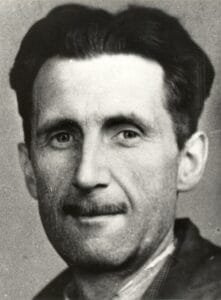
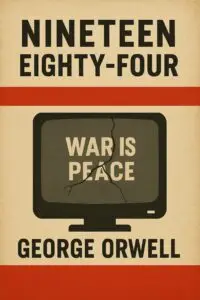
Eric Arthur Blair, known by his pen name George Orwell, was born in British India in 1903 and educated at Eton. Rather than follow a conventional path, he joined the Imperial Police in Burma, an experience that left him deeply opposed to imperialism and authority of all kinds.
He fought in the Spanish Civil War, nearly died from a fascist sniper’s bullet, and watched with horror as Stalinist forces turned on their own allies. That experience shaped everything he wrote afterwards.
Orwell spent much of his adult life in poverty, writing journalism, essays, and novels that combined fierce political clarity with extraordinary prose precision. He died of tuberculosis in 1950, aged 46.
He remains one of the most quoted writers in the English language. Almost everything he warned about is still happening.
Published in 1949, Nineteen Eighty-Four is the story of Winston Smith, a low-ranking member of the ruling Party in the totalitarian superstate of Oceania, where Big Brother watches everything, history is rewritten daily, and even private thought is a crime punishable by death.
Winston works at the Ministry of Truth, where his job is to falsify historical records to match whatever the Party currently claims is true. He begins, quietly and dangerously, to remember things differently. He falls in love. He seeks out what he believes is a secret resistance movement. He makes every mistake a person can make in a world designed to punish hope.
Orwell wrote the book in 1948 while dying of tuberculosis on a remote Scottish island, racing to finish it before his body gave out. The urgency shows on every page. This is not a comfortable book. It was never meant to be.
It gave us Big Brother, doublethink, thoughtcrime, the memory hole, Room 101, and the Newspeak dictionary, concepts so precisely observed that they became permanent fixtures of political language worldwide. Seventy-five years after publication, every one of them remains in active use.
Read it as a novel. Read it as a warning. Read it as a field guide.
Why It Matters:
Orwell finished Nineteen Eighty-Four in 1948. He died eighteen months later. In the seventy five years since, the world he described has not receded, it has advanced.
The mechanisms he identified are not hypothetical. Surveillance infrastructure that would have seemed fantastical in 1949 is now standard. Language is routinely weaponised to mean its opposite — wars are peacekeeping, propaganda is information management, dissent is misinformation. History is rewritten not by ministries with memory holes but by algorithms that bury inconvenient search results and social media platforms that quietly remove posts.
Big Brother didn’t arrive in a jackboot and uniforms. He arrived offering convenience, connection and a personalised feed.
Orwell’s genius was not prediction. It was pattern recognition. He saw clearly how systems of control work — not the dramatic version, but the mundane, administrative, paperwork version that people accept because it arrives gradually and always with a reasonable explanation.
Read this book and you will never look at a news cycle the same way again.
That is precisely why it belongs here.
This text is sourced from Project Gutenberg — the world’s largest collection of free public domain books.