
Nobody knows who Homer was. Nobody knows when he lived, whether he was blind, or whether a single person wrote both the Iliad and the Odyssey at all. What we know is that somewhere in ancient Greece, someone gave the world a story so perfectly constructed that three thousand years of civilisation have not managed to improve on it.
Homer
(circa 8th century BC)
A Warning from the Past. A Mirror of the Present.
Homer is a name attached to two of the greatest works in Western literature — the Iliad and the Odyssey. Beyond that, almost nothing is certain.
Ancient tradition described him as a blind poet from one of several Greek cities, each of which claimed him as their own. Modern scholars have debated for centuries whether Homer was a single person, a composite of multiple poets, or a name given to an oral tradition that crystallised over generations into the texts we have today.
What is certain is that the poems attributed to Homer were foundational to Greek culture — memorised, performed, quoted and revered. Alexander the Great slept with a copy of the Iliad under his pillow. Plato both celebrated and feared Homer’s influence. Every subsequent work of Western epic poetry exists in conversation with these two texts.
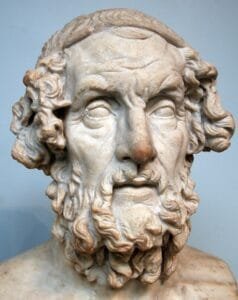
The bust used to represent Homer here is a Roman copy of a Greek original, now held in the British Museum. Whether it depicts Homer at all is unknown. It has become his face by convention — which is perhaps appropriate for a poet whose identity has always been more legend than fact.
Circa 8th century BC. Public domain.
The Odyssey begins where most stories would end. The war is over. Troy has fallen. All Odysseus has to do is go home.
It takes him ten years.
Along the way he encounters the Cyclops Polyphemus, the enchantress Circe, the land of the dead, the six-headed monster Scylla and the whirlpool Charybdis, the Sirens whose song drives men mad, and a goddess who keeps him on her island for seven years because she loves him. Meanwhile his wife Penelope holds off a hundred suitors at home, his son Telemachus grows up without him, and his old dog Argos waits at the gate.
The Odyssey is not just an adventure story. It is a meditation on identity — on what it means to be away from home so long that you have to ask whether home still exists, and whether you are still the person who left. Odysseus is clever, resourceful, brave, and deeply flawed. He makes terrible decisions. He loses all his men. He lies constantly and brilliantly. He is, in other words, completely human.
This edition uses Samuel Butler’s 1900 translation — rendered into clear, readable English prose. Butler’s translation is noted for its directness and accessibility, making one of the oldest stories in Western literature feel immediate and alive.
Author: Homer, circa 8th century BC. Translation: Samuel Butler, 1900. Public domain in Australia.
Why It Matters:
The Odyssey is the oldest story most people have never actually read.
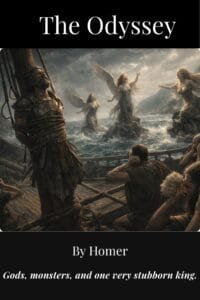
They know the Cyclops. They know the Sirens. They know Odysseus tied to the mast. What they often don’t know is the quiet devastation of the scenes around those famous moments — the encounter with the dead in Book XI, where Odysseus meets the shade of his own mother and cannot hold her; the return of Argos in Book XVII, the old dog who waited twenty years and dies the moment his master comes home; the extraordinary patience of Penelope, who outsmarts a hundred men for two decades through sheer intelligence and will.
These are not adventure story moments. They are human ones. And they have survived three thousand years because human beings have not fundamentally changed — we still leave, we still long to return, we still wonder whether the people we love will still be there when we do.
The Bibliotheca exists to preserve works that illuminate the human condition. The Odyssey is where that tradition begins.
That is precisely why it belongs here.
This text is sourced from Project Gutenberg — the world’s largest collection of free public domain books.