

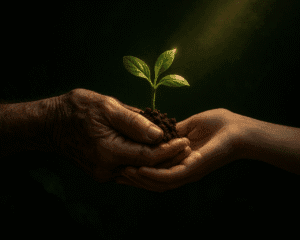
Environmental Legacy
'... Better Than We Found It'
Our environmental legacy is the practical result of our views and values. Every generation inherits a world it did not make. Every generation leaves a world it did not intend.
For most of human history, the gap between what we received and what we returned was small enough to ignore. Rivers ran. Forests grew back. The sky was vast, and the oceans were deep, and the damage we did was local, temporary, and survivable.
That world is gone.
We are the first generation in human history to understand, with scientific certainty, the full scale of what we are doing to this planet. And we may be the last generation with the power to change course. That is not hyperbole. That is the considered conclusion of the world’s leading climate scientists, ecologists, oceanographers, and conservation biologists. The evidence is overwhelming, the timeline is shortening, and the consequences of continued inaction are not abstract. They are measurable. They are already here.
Australia is not a bystander in this story. We are one of the world’s largest per capita carbon emitters. We hold some of the most biodiverse ecosystems on Earth, the Great Barrier Reef, the Daintree, the ancient forests of the southwest, the desert ecosystems of the interior, and we are watching them degrade in real time. We have one of the worst extinction records in the developed world. We are a major fossil fuel exporter. And we sit at the edge of a Pacific Ocean whose rising waters are already erasing the homelands of our neighbours.
We also have an extraordinary capacity to lead.
Environmental Legacy is WeRise’s commitment to civilisational responsibility. Not just national policy — though that matters enormously — but Australia’s role in the global effort to stabilise, restore, and protect the natural systems that every living thing on this planet depends on. It is a commitment grounded in a simple principle:
🌱 Environmental Legacy says that we did not inherit this planet from our parent, but that we are borrowing from our children.
That borrowing comes with obligations. To return the air cleaner than we found it. The water cleaner. The soil richer. The oceans less acidic. The skies — both above our heads and far above our atmosphere — less cluttered with the debris of our carelessness.
This is not a wish. It is a responsibility. And responsibility requires policy, investment, legislation, and the courage to act against powerful interests who profit from inaction.
The challenges are vast but they are not mysterious. We know what needs to be done. The science is settled. The technology exists or is within reach. What has been missing is the political will to treat the natural world not as a resource to be extracted but as a commons to be stewarded — for ourselves, for every other species that shares this planet with us, and for every generation that comes after.
WeRise supports urgent and coordinated action across every domain where human activity is threatening the systems that sustain life. From the depths of the ocean to the edges of low Earth orbit, from the ancient forests of the tropics to the river systems of our own continent, we believe that Australia can and must be a genuine global leader in the work of restoration, conservation, and planetary stewardship.
Because the question is no longer whether we can afford to act.
The question is whether we can afford the legacy of not acting.
The issues below represent the most urgent fronts in this work. Each deserves serious attention, serious policy, and serious investment. Each page explores the problem, the cost of inaction, the global evidence, and the specific actions Australia can take.
This is our watch. This is our responsibility.
Let us be better than what came before us. Let us leave better than we found it.
For more information on our Environmental legacy, check out the Intergovernmental Panel on Climate Change (IPCC), or the UN Environment Programme (UNEP) or the Wildlife Conservation Society (WCS).
Check out the full range of WeRise policies on the WeRise homepage.
🌍Environmental Legacy Issues
Orbital Hygiene
Low Earth orbit is filling up with debris at a rate that threatens to trap us on this planet permanently. We need global governance of space before one chain reaction makes the decision for us.
Global Reforestation
Forests are the lungs of the planet, and we have spent two centuries cutting them down. Restoring them is one of the fastest, cheapest, and most effective climate solutions available to us.
Marine Conservation
The oceans produce half the oxygen we breathe, regulate our climate, and feed billions of people. We are acidifying, heating, and filling them with plastic at a rate no ecosystem can absorb.
Climate Action
The science has been settled for decades. What remains unsettled is our willingness to act with the urgency the evidence demands.
River Restoration
Fresh water is the most fundamental resource on Earth and we have spent generations treating our rivers as drains. Restoring river health means restoring the communities, ecosystems and food systems that depend on them.
Desertification
Beneath our feet is one of the most complex and vital ecosystems on Earth, and we are destroying it with industrial farming, chemical overuse, and neglect. Healthy soil feeds the world. Degraded soil starves it.
Indigenous Stewardship
The world’s Indigenous peoples protect 80% of Earth’s remaining biodiversity while comprising less than 5% of the global population. The most effective environmental policy we could adopt is simply to listen to them.
Plastic Pollution
There is plastic in the deepest ocean trench, in Arctic ice, in human blood, and in the bodies of unborn children. We created a material designed to last forever and then treated it as disposable.
Atmospheric Protection
Seven million people die from air pollution every year more than malaria, tuberculosis and AIDS combined. Clean air is not a luxury. It is a human right that our current systems treat as an acceptable casualty of economic growth.