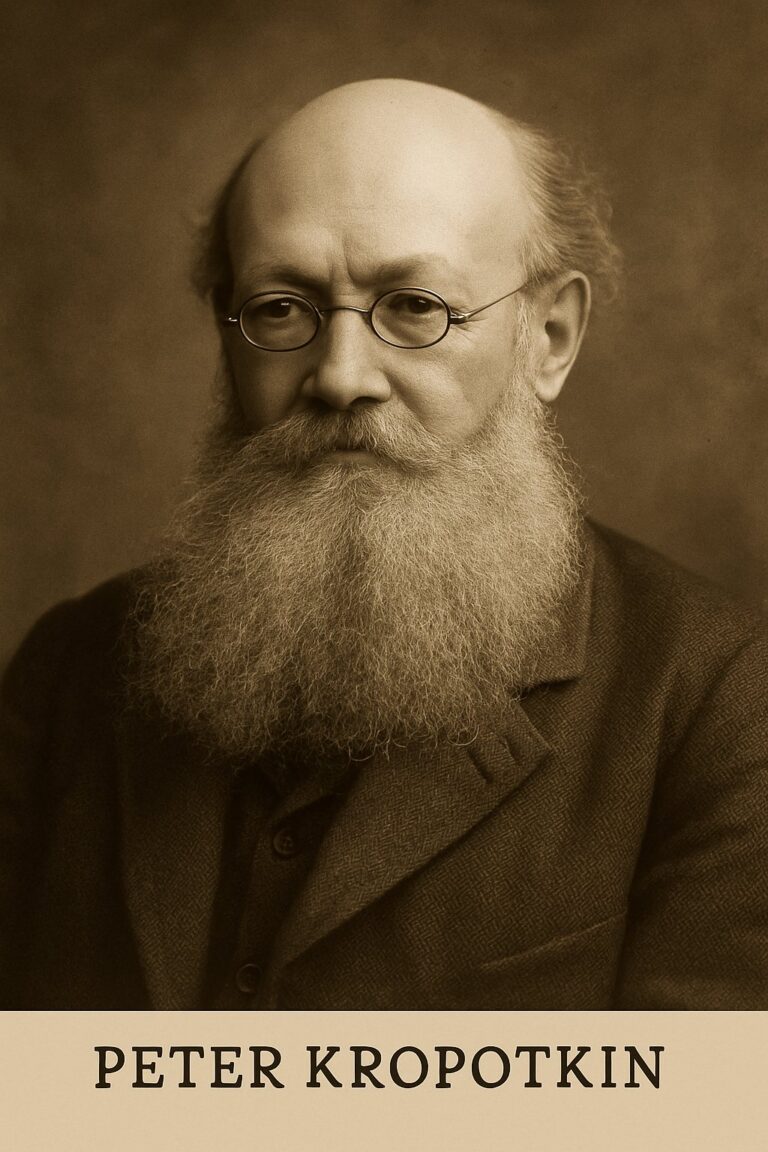
The Conquest Of Bread
Peter Kropotkin (1842–1921) was a Russian prince turned anarchist, scientist, and revolutionary thinker. Disillusioned with both monarchy and Marxist authoritarianism, he became one of history’s most influential advocates of decentralized cooperation.
Rather than endorsing violence or control, Kropotkin’s approach to social change emphasized mutual aid, voluntary association, and a belief in the innate capacity of people to build just societies from the ground up. He saw compassion not as weakness but as the evolutionary glue of successful communities.
His legacy continues to shape political discourse far beyond anarchist circles — influencing everything from modern socialism to ecological movements and mutualist economics.
The Conquest of Bread is his most enduring work, presenting a powerful case for reimagining how societies can function without coercive institutions or capitalist exploitation.

"Well-being for all. Not charity, but justice.
A stirring call to arms and a blueprint for change, The Conquest of Bread outlines Kropotkin’s vision of a society built on equality, abundance, and solidarity.
Rejecting the harsh realities of both exploitative capitalism and authoritarian communism, Kropotkin proposes a decentralized economic system rooted in shared ownership, collective responsibility, and mutual aid. His argument is not simply moral — it is deeply pragmatic, grounded in real-world examples and scientific observations of cooperation in nature and society.
First published in 1892, The Conquest of Bread critiques the injustice of hoarded wealth and idle elites, while highlighting how scarcity is artificially maintained for profit. Kropotkin argues that with available technology and coordinated effort, it is entirely possible to provide for all — without the need for centralised control or rigid hierarchies.
He challenges the reader to rethink the foundations of work, property, and power. Why should millions go hungry while food rots in warehouses? Why are human beings conditioned to compete when collaboration has always been our greatest strength?
This book isn’t a utopian fantasy — it is a direct, achievable challenge to the systems that surround us. Kropotkin’s call is as relevant today as it was in the 19th century: that every person deserves dignity, shelter, and access to life’s essentials, not through charity, but through solidarity.
As automation, inequality, and ecological crises reshape our world, The Conquest of Bread has re-emerged as a touchstone in discussions around degrowth, post-capitalism, and sustainable community living.
Its critiques remain sharp, its solutions grounded, and its tone remarkably hopeful.
This edition of The Conquest of Bread is presented as part of our curated library of visionary thinkers — works that challenge power, stir the soul, and imagine better futures.
Readers are encouraged to approach with an open mind and a willingness to question the status quo. For all who seek to understand the ideological foundations of grassroots resistance and mutual liberation, this book remains essential reading.