
The Conquest of Bread
In 1892 a man who had been born into Russian aristocracy, educated at the Tsar’s elite military academy, and offered the highest honours his empire could bestow — sat in exile and wrote a book arguing that private property was the root of all human suffering. Peter Kropotkin had seen both worlds. He chose a side..
Peter Kropotkin
(1903-1950)
A prince who gave up everything to imagine a world without masters.
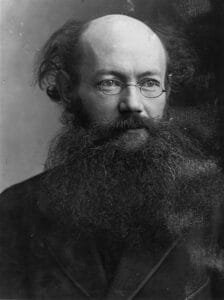
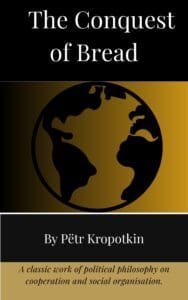
Peter Alexeyevich Kropotkin was born in Moscow in 1842 into one of Russia’s most distinguished aristocratic families — a prince by birth, a page at the Tsar’s court by appointment, and by every measure of his society a young man with an extraordinary future ahead of him.
He walked away from all of it.
After serving as a military officer in Siberia — where he witnessed firsthand the brutal conditions imposed on peasants and prisoners — Kropotkin returned to St Petersburg, joined a revolutionary circle, and was arrested by the Tsar’s secret police. He escaped dramatically from a prison hospital in 1876, fleeing to Western Europe where he would spend most of the rest of his life in exile, writing, organising and thinking.
He was imprisoned again in France. He was expelled from Switzerland. He was welcomed in England, where he lived for thirty years and wrote his most important works.
He returned to Russia after the 1917 revolution — and was deeply troubled by what he found. He met Lenin personally and warned him that the Bolshevik methods would destroy the revolution’s ideals. History proved him right.
Kropotkin died in 1921. His funeral in Moscow was the last great public anarchist demonstration in Russia. Tens of thousands marched. Within months his ideas were officially suppressed.
He was right about almost everything. That is precisely why they suppressed him.
The Conquest of Bread begins with a simple observation: the world produces enough food, clothing and shelter for everyone. And yet most people have too little while a few have far too much. Kropotkin asks why — and then, more importantly, asks what a genuinely different arrangement might look like.
His answer is neither capitalism nor state socialism. It is mutual aid — the idea, backed by his extensive study of both human history and natural science, that cooperation is more fundamental to survival than competition. That people, given genuine freedom and genuine security, will contribute to their communities not because they are forced to but because it is in their nature to do so.
The Conquest of Bread is not a utopian fantasy. It is a practical argument, worked through in careful detail, about how food could be grown, distributed and prepared, how housing could be allocated, how clothing could be made — in a society organised around need rather than profit.
It is also, quietly, one of the most radical challenges to the assumptions of modern economics ever written. The assumptions it challenges have not gone away.
Published 1892. Author: Peter Kropotkin. Public domain in Australia.
Why The Conquest of Bread Matters:
Kropotkin wrote The Conquest of Bread at a moment when industrial capitalism was producing extraordinary wealth and extraordinary misery simultaneously — when children worked in factories, when families starved in the shadows of full granaries, when the gap between those who owned and those who worked was widening faster than anyone could measure.
In 2026 the specifics have changed. The structure has not.
What Kropotkin understood — and what mainstream economics has spent over a century trying to explain away — is that scarcity is largely manufactured. That the systems we have built to distribute resources are not natural laws but choices. That different choices are possible.
The Conquest of Bread is not a perfect book. Some of Kropotkin’s assumptions about human nature are optimistic to the point of naivety. Some of his practical proposals have not aged well. But the core argument — that a society organised around mutual aid and genuine cooperation could meet everyone’s needs — has never been seriously refuted. It has only been ignored.
In an era of automation, artificial scarcity and widening inequality, the questions Kropotkin asked in 1892 are more urgent than they have ever been. WeRise exists in part because we believe he was asking the right ones.
That is precisely why it belongs here.
That is precisely why it belongs here.
This text is sourced from Project Gutenberg — the world’s largest collection of free public domain books.