
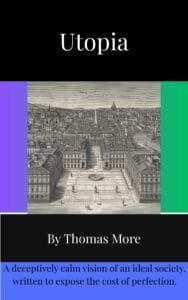
In 1516 a lawyer wrote a book about a perfect island that didn’t exist. He called it Utopia — the nowhere place. Five hundred years later we are still arguing about whether he was right that it couldn’t.
Sir Thomas More
(1478-1535)
"A man of remarkable gifts, who died rather than betray his conscience." —Winston Churchill
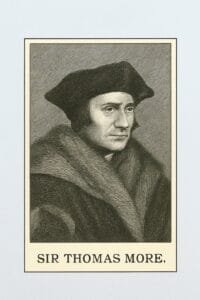
Thomas More was born in London in 1478, educated at Oxford, and became one of the most distinguished lawyers and humanists of his age. He served Henry VIII as Lord Chancellor — the highest legal office in England — and was by any measure a man of extraordinary intelligence, principle and ambition.
He was also, ultimately, a man who could not lie for a king.
When Henry VIII broke with the Catholic Church to pursue his divorce from Catherine of Aragon, More refused to endorse it. He resigned as Lord Chancellor, retreated into private life, and maintained a careful public silence. It wasn’t enough. He was arrested in 1534, imprisoned in the Tower of London, and executed in 1535 for treason.
He was canonised as a saint by the Catholic Church in 1935 — four hundred years after his death.
More wrote Utopia in 1516, nineteen years before his execution, when he was still a rising star at the court of a king he may have already had doubts about. Whether Utopia was a genuine vision or a very careful piece of satire has been debated ever since.
That ambiguity is part of what makes it extraordinary.
In 1516 an English lawyer named Thomas More wrote a small book describing a perfect island society where poverty had been abolished, war was rare, and religious tolerance was law. He called it Utopia (from the Greek for “nowhere”” and in doing so accidentally invented one of the most powerful and contested ideas in human history.
Utopia is not a blueprint. It is a provocation. More used his fictional island to hold a mirror to Tudor England, its inequality, its cruelty, its casual acceptance of suffering, and ask quietly whether things had to be this way. The question proved impossible to unask.
Every utopian vision that followed — and every dystopian warning — traces its lineage directly to this slim, mischievous, quietly radical book written by a man who would later be executed by the king he served.
Published 1516. Author: Thomas More. Public domain in Australia.
Why It Matters:
Thomas More invented a word that now belongs to everyone. Utopia. The nowhere place. The impossible dream. The thing worth reaching for precisely because it cannot be fully reached.
Every political movement that has ever promised a better world — every revolution, every manifesto, every platform — is in some sense a response to More’s original question: what would a genuinely fair society actually look like? The answers have varied wildly. The question has never stopped being asked.
What makes Utopia remarkable is not that More had all the answers. It’s that he asked the question so clearly, so early, and with such obvious awareness of how dangerous the asking was. He lived in a society where the wrong ideas could get you killed. He wrote the book anyway.
In 2026 the question More asked in 1516 has not been answered. Inequality persists. War persists. The casual acceptance of preventable suffering persists. The Bibliotheca exists in part because we believe the question is still worth asking — and that the people who asked it first deserve to be read.
More was executed for refusing to say something he knew to be untrue. The Atlas Bibliotheca exists because truth still matters.
That is precisely why it belongs here.
This text is sourced from Project Gutenberg — the world’s largest collection of free public domain books.